
Resignation Isn’t Loyalty. And FMCG Is Confusing the Two
Two senior executives examine whether the consumer goods industry is facing a structural problem or relying on a resilient asset.
The discussion brings together Johan Wahlström, Client Partner at Pedersen & Partners, specialising in FMCG, Consumer Health, and Manufacturing, and Alan Thompson, board-level CEO and Senior Advisor with extensive experience across consumer products, health, personal care, private equity, and PLC businesses.
The Unspoken Bargain
Who remembers “Love Brands”? The idea was everywhere 20 years ago, and it captured an unspoken bargain at the heart of consumer branding: The consumer agrees to pay a price, remain loyal, and keep coming back. In return the brand delivers consistent value, behaves honestly, and earns that loyalty. Decades of brand equity have been built on this assumption.
Many believe that trust is now under pressure. Not dramatically or all at once, but through thousands of small decisions made in boardrooms and finance committees: decisions to prioritise margin protection over consumer value. Consumers, armed with more information and more alternatives than at any point in history, are noticing. When they do, the consequences can be significant in terms of PR and results.
Johan Wahlström, who has spent years working with FMCG businesses at board and C-suite level across Europe and beyond, believes the industry is sitting on a structural problem it has yet to fully price in. Alan Thompson, CEO & former Chief Customer Officer at Reckitt who advises various PE-backed consumer businesses, thinks the diagnosis overstates the damage and underestimates the resilience of strong brands. What follows is their argument.
What Value Extraction Actually Looks Like
Johan Wahlström
Value extraction from the consumer takes many forms. The most discussed right now is shrinkflation — reducing the size or
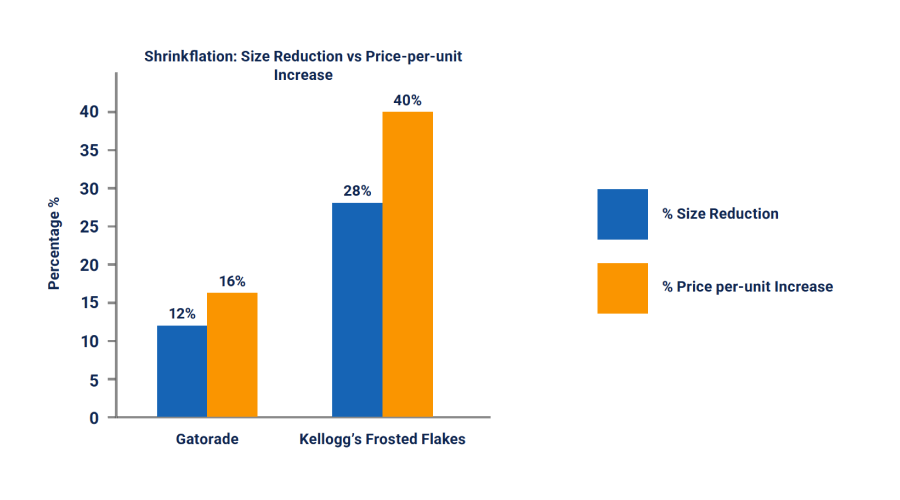
weight of a product while keeping the price the same or raising it. One study found that shrinkflation averaged >11% across
national grocery brands in 2023. Gatorade shrank its flagship bottle. Kellogg’s family-sized Frosted Flakes did likewise — a
reduction that translated into a 40% increase in price per ounce.
Alan Thompson
The first thing to say is I’ve sat in that room and I’ve been that guy! In various roles I’ve shrunk the size, changed the packaging, increased the price, run the “cost-out” team, had the fight with the retailer, etc, and all to maintain margin and grow revenue.
But based on all that I can confidently confirm: these decisions are tough. You can’t just “shrink” the product. You might need new tooling, there will be barcode and listing fee issues, trade will kick up a storm, there’s PR risk, and almost certainly there will be markdowns, obsolete stock and write offs. Believe me, if I could just “put a price increase through”, I would.
Johan Wahlström
What I notice in board conversations across the sector is how rarely the long-term cost of shrinkflation gets discussed with the same seriousness as the short-term gain. The margin case is straightforward to build. It sits in the numbers. The trust case is harder to put in a spreadsheet, so it tends to get acknowledged and then set aside.
I am not sure the industry has fully reckoned with the long-term consequences that this habit of thinking is quietly compounding over time.
Alan Thompson
I like to think about the Skippy case* in this conversation. It got huge scrutiny at the time, and secretly I thought the dimple idea was quite smart! But roll forward to today, and Skippy is still one of the best-selling peanut butters in America. Consumers noticed, some were angry, and … the brand absorbed it.
The more interesting question is not whether these decisions are sometimes unpopular, some clearly are, but whether they are as commercially fatal as the critics claim. The evidence at the till suggests they often are not.
*During the 2008 financial crisis, the brand shrank its jars from 18 ounces to 16.3 ounces and added a glass dimple to the base so the two sizes appeared identical on shelf.
The Consumer has Noticed - but are They Actually Leaving?
The data on consumer awareness is not in dispute. A LendingTree study found that 71% of Americans had noticed shrinkflation, and 66% of those said they had stopped buying specific products as a result. Across multiple studies, roughly three in four consumers say they would have preferred an honest price increase to a hidden size reduction. They were willing to pay more. They simply wanted to be told the truth.
Johan Wahlström sees those numbers as a structural warning. Alan Thompson reads them rather differently.
Alan Thompson
Consumers say one thing and often do another. Almost every decision tree I ever saw said price was the most important factor, but as soon as I asked them to choose from a shelf the results were different. That’s not to say you can rip off consumers or that they never notice, just that I’m sceptical when I hear that consumers are flooding away from brands.
The more reliable data is what happens at the till. Coca-Cola’s revenue in 2024 was $47 billion, up from $38.7 billion in 2021, and it has kept growing since. Mondelez delivered >14% OSG in 2023. If consumers were voting with their wallets as decisively as the attitudinal surveys imply, those numbers would look different.
Also, tracking in the UK* found that brand-switching intent due to shrinkflation fell from 50% in 2023 to 36% in 2025. Researchers called it the resignation effect. Consumers are annoyed. They have worked out what is happening, and then they mostly buy the same products.
*YouGov
Johan Wahlström
The resignation effect is real, and I do not dismiss it. But resignation is not loyalty. A consumer who stays because switching feels like too much effort is not the same as a consumer who stays because they believe in the brand. The first is a habit. The second is an asset.
What concerns me is that FMCG businesses are increasingly counting on the habit while running down the asset. That works until it doesn’t, and when a habit breaks, it breaks quickly.
The headline revenue figures still look reasonable. But if you look at where the growth is actually coming from, which brands, which formats, which channels, the picture is less comfortable than the top-line numbers suggest.
Resignation is not loyalty. A consumer who stays because switching feels like too much effort is not the same as one who stays because they believe in the brand.
The Challenger Window - and How Long it Stays Open
Every act of value extraction by an incumbent opens a window for a challenger. The gap between what the consumer expected and what they received is the space a new brand needs to get distribution, gain trial, and build momentum.
The Toblerone case illustrates both sides of that argument. When Mondelēz shrank the iconic bar in 2016, widening the gaps between its triangular peaks so that the 170-gram bar became 150 grams at the same price, the consumer reaction was immediate. Poundland launched Twin Peaks, a twin-bar format that stepped directly into the trust void Mondelēz had created and generated £12 million in sales before Mondelēz’s lawyers intervened. The incumbent had to resort to litigation to close a door it had opened with its own pricing decision. That is the version of the story most people know.
What happened next is less often told. Mondelēz restored the bar to its original shape in 2018, relaunched it at 200 grams with a significant brand refresh, and the business has performed strongly since. The brand is super strong in travel retail with exclusive flavour innovations and occasion-led campaigns. Wahlström and Thompson draw different conclusions from this story.
Alan Thompson
The lesson I take from Toblerone is not that incumbents don’t make mistakes. It is that the ones with strong enough brands can absorb a mistake, correct it, and come back. The ones without that equity cannot.
Having a big brand doesn’t immunise you against doing something stupid, but decades of investment in building a brand delivers equity benefits. Poundland got £12 million in sales and a court order. Mondelēz still has one of the most recognisable confectionery brands on the planet.
That is what distribution scale and consistent investment in brand equity actually buys you, assuming you have some smart people who can navigate the choppy waters.
Johan Wahlström
The recovery argument is valid for a brand the size of Toblerone. My concern is that it is being used as a general-purpose reassurance when it only applies to a relatively small number of businesses with genuinely exceptional brand equity.
For every Toblerone there are ten brands that do not have that cushion, that are a few percentage points of private label share away from a structural problem they cannot price-invest their way out of.
The window a challenger needs is shorter than it used to be. A pricing decision made quietly on a Tuesday can be a reputational problem by Thursday. Most incumbents are still planning on the old timeline.
In beverages, the challenger dynamic is playing out at speed. Olipop and Poppi built honest, functional propositions into the space left by years of reformulation and price increases from Coca-Cola and PepsiCo. Olipop surpassed $400 million in annual sales in 2024, with roughly half its growth coming from consumers switching out of legacy carbonated drinks. Poppi was acquired by PepsiCo for $1.95 billion, with the deal announced in March 2025 and completed in May 2025.
Thompson’s reading: a large incumbent spotted a trend, watched a smaller company absorb the development risk, and bought the result.
Wahlström’s reading: an incumbent had to spend $1.95 billion to buy growth it could have been generating organically.
The Private Label Question
Behind the high-profile challenger cases is a quieter but more structurally significant shift: the erosion of the quality stigma around own-label. For decades, the FMCG incumbent’s last line of defence was the consumer’s assumption that retailer brands were inferior. That assumption has been systematically dismantled.
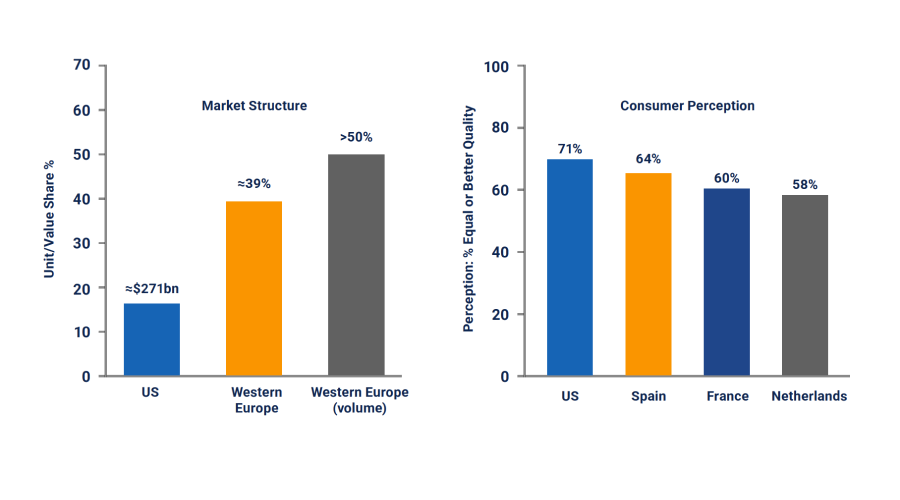
Private label brands in the US reached $271 billion in sales in 2024, per PLMA/Circana, capturing approximately a 23% unit share of the market. In Western Europe, private label now accounts for approximately 39% of total FMCG value sales and over 50% by volume in the six largest markets, according to NielsenIQ/PLMA and Circana data from 2024–2025.
A 2023 Simon-Kucher study of 8,000 consumers across seven countries found that over half now purchase private labels predominantly or exclusively, as high as 64% in Spain, 60% in France, and 58% in the Netherlands. Seventy-one percent of US shoppers now say private-label quality is equal to or better than national brands.
Johan Wahlström
The consumer no longer needs the heritage brand. They are choosing it, when they choose it, on the basis of value and trust.
The private label data tells you what happens when that value proposition weakens. It does not happen in a single dramatic moment. It happens in thousands of small basket decisions, week after week, until one day the volume figures finally reflect what the shopping behaviour has been saying for some time.
Alan Thompson
Private label share figures are real, but the trajectory is not inevitable if brands fight smart. The first time I was told that private label was going to destroy brands was 1991, when a UK retailer launched an own-label detergent. Yet here we are in 2026, and Ariel is still going strong.
The category dimension matters enormously, and most don’t pick up the nuances. Some of the strongest own-label shares are in higher-priced retailers such as Waitrose, Sainsbury or Loblaw. Much of the growth in own label recently has been in their premium range, for example Tesco’s Finest.
Own label significantly outperforms in commoditised categories: pasta, canned goods, basic cleaning products. It underperforms where brand carries genuine functional or emotional weight: baby food, prestige personal care, premium confectionery. Toblerone at over £3 a bar is competing as much with other gifting products as with own-label chocolate.
You can’t be complacent. Brands need to fight against commoditisation. But treating the threat as uniform overstates the risk for most of the businesses I advise. And it under-calls the business risk from other factors, such as poor retail execution.
Innovation: The Argument the Critics Underplay
The debate about shrinkflation and private label share risks missing something that the most resilient incumbents understand well: the brands that hold their position over time are not simply defending existing products. They are giving consumers new reasons to choose them.
Toblerone’s travel retail expansion, exclusive formats, occasion-led campaigns, flavour innovations, is one example of an incumbent using brand heritage as a starting point rather than a refuge. P&G’s continued investment in premium formats across personal care, Unilever’s expansion in functional nutrition, and Coca-Cola’s moves into energy and hydration tell the same story: companies that treat innovation as a standing commitment generate new reasons for consumers to choose them that have nothing to do with the original grievance.
Alan Thompson
The criticism of FMCG incumbents focuses almost entirely on what they have taken away. It pays much less attention to what they are creating.
The brands that are genuinely in trouble are not the ones that had a difficult year on shrinkflation. They are the ones that stopped innovating, that relied on legacy equity and margin management and had nothing new to say to the consumer.
Innovation doesn’t repair broken trust, but it creates new trust before the old kind runs out. The companies that understand that distinction are in a fundamentally different position from the ones that don’t.
Johan Wahlström
I accept that. But the innovation argument is only as strong as the execution behind it. Many incumbents announce innovation pipelines that take too long to reach the consumer at scale.
Challengers move faster, build a community first, and arrive in distribution with momentum already behind them. Speed matters as much as investment.
Innovation gets you the right to compete. It does not by itself determine who wins.
The Talent Question: Innovation and the Art of Selling a Price
Both sides of this debate arrive at the same conclusion by different routes: that navigating this period successfully is a question of leadership capability. But the capability requirements are more specific than the industry tends to acknowledge, and conflating them is itself part of the problem.
The innovation argument, which both Wahlström and Thompson support, requires a particular kind of leader inside a large FMCG business: someone who can push longer-cycle investment through an organisation and has the vision to define innovation broadly beyond only doing “NPD”, despite next quarter’s margin being the dominant metric. That person can be the same person who runs a tight P&L, but not always.
Alan Thompson
The other talent gap that nobody talks about enough is in the sales function. The ability to take a price increase through the trade, to sit across the table from a major retailer and make the case well enough that they accept it, hold the line under pressure, and list the product at the new price without a promotional concession that gives back everything you gained, is a genuine and specific skill.
It is not picked up in a seminar or via AI. The best commercial operators I have worked with know how to manage a price negotiation and have the scars to prove it.
That requires credibility built over time, a real relationship with the buyer, and the judgement to know when to push and when to fall back.
When that capability is missing, and the honest price conversation feels too risky, where do you go?
Johan Wahlström
What I look for in FMCG leadership today is the combination: someone who can hold the long-term brand equity argument in a room where the short-term margin case is considerably easier to run, and who also has the commercial credibility to take a price story to market and make it stick.
That combination is rarer than most job specifications acknowledge. The organisations that find it tend to do both things, innovate and price, with more confidence than the ones that treat them as separate problems assigned to separate people.
The Open Question
Bain & Company’s 2025 Insurgent Brands report identified 120 challenger brands in the US that together drove 39% of incremental growth within their categories while accounting for under 2% of total market share. The incumbents held the other 98% of the market. But they captured only 61% of the growth.
That number sits differently depending on where you stand. For Wahlström, it is evidence that incumbents are already losing the future while they appear to be holding the present. For Thompson, it is evidence that the incumbents’ structural advantages, distribution, capital, brand recognition, innovation budgets, remain formidable, and that the challenger threat, real as it is, has been cast as more existential than the data supports.
What both would agree on is this: the brands that earn the next decade of loyalty will not be the ones that extracted the most from their consumers during a difficult period. They will be the ones that invested in genuine innovation, communicated honestly about price, and made decisions they could defend in public without a crisis communications team on standby.
That is not a point of disagreement between these two. It is the one thing on which the argument, for all its vigour, has found common ground.